
Tips to Maximize ADHD Coaching
ADHD coaching is a big investment in yourself.
It takes money, time, mental energy, and a willingness to look at what is and isn't working. It makes sense to want to get as much out of it as possible.
The good news: you do not have to do all of the things below to benefit from coaching (or even any of them). I have clients who don't do most of this and still make meaningful progress. It's a very personal journey.
But if you want to stack the deck in your favor and make faster progress with an ADHD coach, these are the things I've noticed help speed up the process.
(Or you could watch the video first.)
1. Start coaching when you actually want things to change
You do not need to show up to coaching with a perfect plan. You do not need a fully formed set of goals or a dramatic life manifesto.
What does help is to start coaching at a time when you feel genuine motivation for things to be different from what they are right now. The desire for change is what matters.
This motivation does not have to be neat and organized. It could sound like:
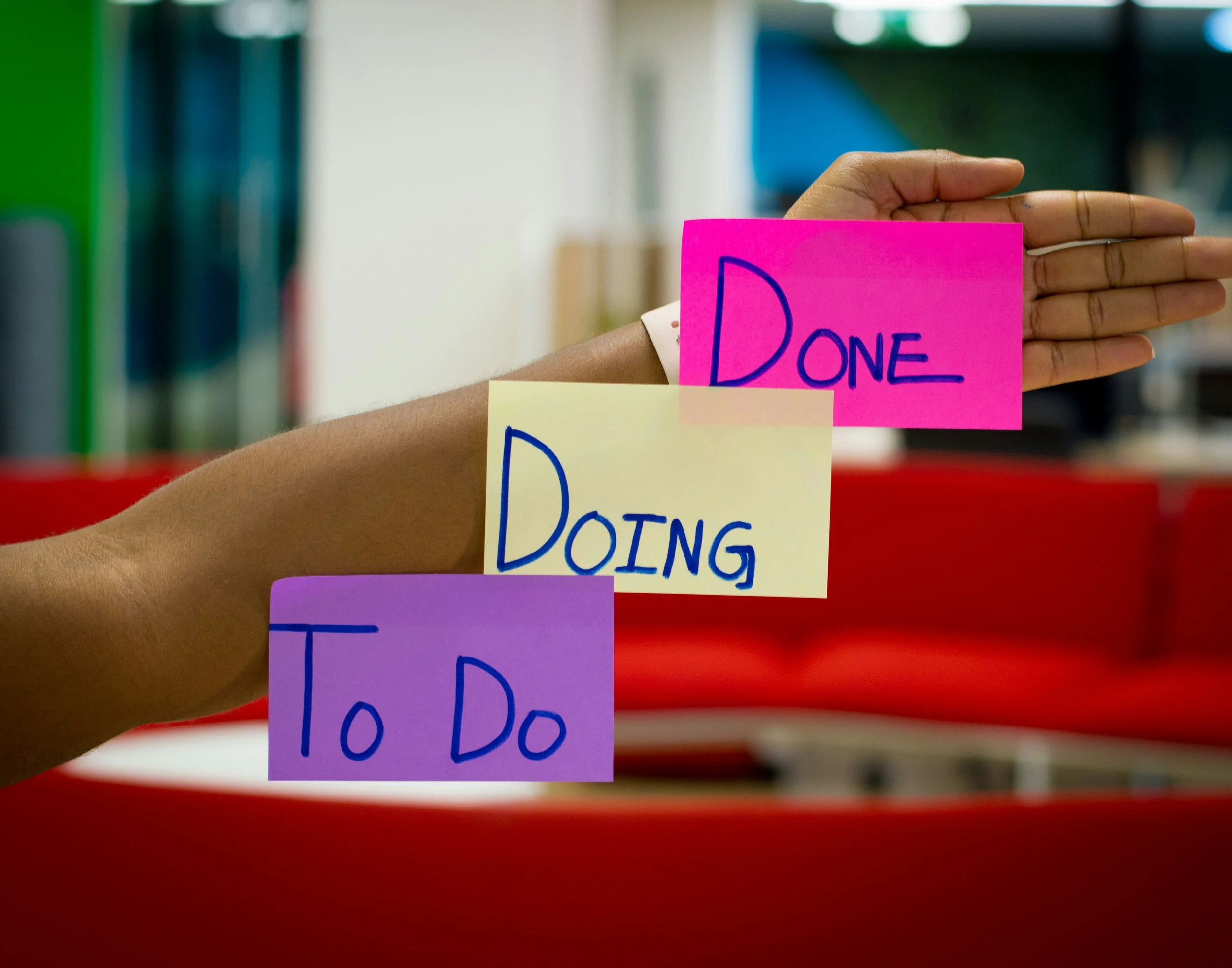
Three sticky notes on a mirror. The bottom one is purple and has "to do" written on it. Above that is a yellow sticky note that says, "doing", and at the very top is a pink sticky note saying, "done".
- "I can't keep doing this the same way."
- "Something needs to change."
- "I'm tired of fighting with my brain alone."
- "I don't know exactly what I need, but I know this isn't working."
That's enough. You can figure out the specifics with your ADHD coach.
2. Have a dedicated place for ADHD coaching notes
Have one place for coaching-related thoughts. That can be:
- a note in your notes app
- a Google Doc, Word, or Pages document
- a paper notebook
- a chaotic but beloved planner situation
- whatever you will actually use
It doesn't matter what format it is. It matters that it exists and it feels accessible to you. This is a great place to keep:
A. Things to write down between coaching sessions

a woman sitting down, taking notes
- notes from coaching sessions
- discoveries you make about yourself
- things you said you wanted to try before the next meeting
- questions you want to ask your coach that occur to you in between sessions
- topics you might want to cover in a future session
- wins you want to remember or brag about
You can also keep your bigger-picture coaching goals there, so you can come back to them and reflect on whether the work you're doing is helping.
Unquestionably, the clients who make the fastest progress are those who actively capture what they're learning.
B. Bonus points: keep a Personal Operations Manual
If you already have something like a Personal Operations Manual, even better. That can be the place where the bigger life-lessons go:
- things that help you get started (some people need a variety pack of options, and what works changes with our phases of life)
- what derails you
- the kinds of accountability work best for you
- what your brain does under stress
- patterns keep repeating in your life
- what actually helps you
You're not just collecting coaching notes. You're building a reference manual for how you work. Very handy, since apparently no one shipped us with one.
3. Give yourself some runway time before each session
Let me say it again for the people already preparing to feel bad: This is not required.
But if you want to make the most of your session time, it helps a lot to block off some time before coaching. Ideally, somewhere in the 30-60 minute range.
You can use this time in a few different ways:
A. Review your notes and decide what you want to work on together in the session
Before your session, you can ask yourself:
- What's been hard lately?
- What am I stuck on?
- What do I want help thinking through?
- What did I say I'd do last time?
- What happened when I tried it?
- How could the coach help me with what's next?
Even five to ten minutes of reflection can help you walk into the session with more clarity and momentum.
And if you struggle to come up with topics, that's okay, too. I have resources on good ADHD coaching topics and how to tackle difficult coaching topics for exactly this reason. And you can always ask your coach. I often take notes on things that might be helpful to cover when the client has capacity.
B. Use the time as a deadline for a small dreaded task
This is one of my favorite sneaky strategies. Some people use the time before coaching to knock out a small but annoying task they've been avoiding. Or a deadline for something you'd told your coach you would do.
Maybe it's:
- making the phone call
- sending the email
- scheduling the appointment
- filling out the form
- doing the tiny admin task that has become emotionally haunted
There are two big benefits here.
First, you get the win.

a woman sitting at her desk making a phone call
Second, you don't have to spend time in session rehashing how to get the thing yet again.
I have absolutely done tasks right before a coaching session because I did not want to have another conversation about why I hadn't done them. Or use our session time on this phone call yet again.
C. Use AI to get your thoughts started
Some clients also use AI before coaching to help them untangle a topic a bit before the session.
That can be useful for things like:
- identifying what feels hard
- naming patterns
- brainstorming possible coaching topics
- organizing messy thoughts into something more discussable
- helping us decide what we want
Basically: see what you can whittle away with the cheap robot before bringing it to the expensive human.
Not because AI should replace coaching. It can't. But sometimes it can help us show up with a head start.
Again: Please don't feel bad if you don't do this
At least half my clients do not consistently set aside prep time before sessions.
They are not "doing coaching wrong." They are often just busy, overloaded, and/or exhausted.
4. Try the stuff we talk about between sessions
Coaching works best when we actually test things in real life between sessions.
Not "be perfect at". Not because you need to perform for your coach. Just test what we come up with.
Because coaching is an experimental process. We come up with ideas. You try them. Then we look at what happened.
That means:
- It is not a failure if it didn't work
- It is not a failure if you did it imperfectly
- It is not a failure if you tried it once and hated it
That is still data. And data is useful.
In this case, Yoda is wrong
"Do or do not, there is no try" is great for movie drama, but frankly, not helpful here.

a man rock climbing a mountain
In coaching, trying counts. An attempt gives us something to work with. Then we can try to find:
- What got in the way?
- Was part of it unrealistic?
- What helped?
- What needs tweaking?
- What we should try differently next time?
5. Protect the session from interruptions
Interruptions are expensive. Not just in time/money, but in brainpower and fatigue in the long run.
When a coaching session is interrupted, we often lose momentum and context, and then have to spend extra time and energy getting back to where we were. Sometimes we do get back into the rhythm. Sometimes we don't.
So, if possible, set yourself up to have as few disruptions as possible.
A few ways to minimize interruptions
- Turn on Do Not Disturb (or use a meeting or Focus Mode)
- Choose a location where other people are less likely to interrupt you
- Minimize background noise
- Don't schedule the meeting during something else, and try to multitask
- Don't leave the TV (or YouTube) on. Even muted. Eyes and attention get diverted
That last one may seem obvious, but just in case.
You do not need a perfect environment. But the fewer competing inputs your brain has to manage, the more useful the session usually is.
6. Get a therapist, if one is needed
Sometimes people are trying to get the most out of coaching, but another unmet need is slowing everything down. One common example: needing therapy, but not having it. Or needing a better therapist.

a woman sitting on a couch talking to her therapist
Coaching and therapy are not the same thing, and sometimes progress in coaching is slower because there is pain, trauma, depression, anxiety, grief, or emotional processing that really belongs in therapy.
That does not mean coaching can't still help. It often can. But if therapy would be helpful and you don't have a therapist, that missing support can make coaching harder than it needs to be.
The good news: a coach can often help with the practical side of that process, too, including accountability around actually finding a therapist if the search feels overwhelming.
"Find a therapist" is one of those tasks that can be so nebulous it never gets started.
None of this is required
Let's end where we began: you do not have to do these things to benefit from coaching.
You are not failing at coaching if these things aren't happening. You can still make progress.

a neon sign reading, "It always seems impossible until its done.”
This list is not a requirements list. It's a list of things I've noticed tend to help people get results faster and hit their goals sooner.
But if you're stuck, not making progress, or waiting until you can do all these things, I beg you: don't wait! Please get what you need when you need it, and lots of folks don't get there on their own. Don't wait.
What helps you get more out of support?
Have you found anything especially helpful when working with a coach, therapist, or other professional? Did I miss something that makes a big difference for you?
Reply and let me know. I'm always curious what actually helps people and I can’t see everything.
Best,
Brittany & Ollie